08.01.26
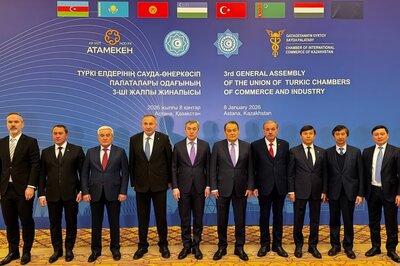
This year, Kazakhstan has assumed the chairmanship of the Union of Chambers of Commerce and Industry of Turkic-Speaking Countries. The announcement was made at the organization’s 3rd General Assembly held in Astana. Since 2019, the union has included Azerbaijan, Kyrgyzstan, Turkey, Uzbekistan, and Turkmenistan. During the meeting, Hungary’s official membership was also confirmed.
The Turkic economic area encompasses more than 180 million people and possesses substantial industrial and resource potential. The union’s main objectives are to expand mutually beneficial cooperation, develop industrial collaboration and joint projects, and enhance international routes and transport corridors. In this context, the effective use of the Turkic Investment Fund’s instruments is envisaged.
According to Vugar Zeynalov, Deputy Chairman of the Azerbaijan Entrepreneurs Confederation, the fund began operations this year and represents one of the most significant achievements of the current chairmanship. One of the initiatives submitted to the fund focuses on increasing trade flows across the Caspian Sea, which is of strategic importance for strengthening unity among Turkic countries. A major commercial cargo flow is already beginning to take shape in the Caspian region.
The Turkic direction is among the key priorities of Kazakhstan’s foreign economic policy. Based on the results of January–October last year, Kazakhstan’s trade turnover with Turkic countries reached USD 11 billion, marking a 10% increase. The majority of this growth came from exports. Exports to member states rose by nearly 17%, approaching USD 8 billion, indicating an improvement in the qualitative structure of Kazakhstan’s export portfolio. The country’s experience in optimizing logistics is expected to make a positive contribution to the union’s activities.
Raimbek Batalov, Chairman of the Board of the Atameken National Chamber of Entrepreneurs and Chairman of the Union, emphasized that transport and logistics challenges require targeted investments in bottleneck areas that hinder trade. These primarily include railway crossings, maritime routes, and shortages of transport capacity. In addition, there is a need to harmonize cross-border document circulation. An initiative to digitalize this process has already been launched, with Kazakhstan serving as a positive example.