16.06.26
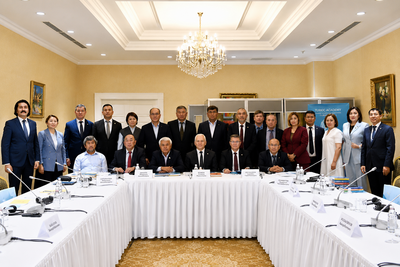
The 4th Meeting of the Common Turkic Alphabet Commission, organized jointly by the Turkic Academy and the Turkish Language Association (TDK), concluded successfully in Astana, the capital of Kazakhstan. During the meeting, the “Implementation Guide” and the alphabet variants of member countries were approved, paving the way for the practical adoption of the 34-letter Common Turkic Alphabet that was accepted in Baku last September.
Speaking at the opening session, President of the Turkic Academy Prof. Dr. Shahin Mustafayev noted that interest in the project has been steadily increasing. The meeting was attended by commission members from Azerbaijan, Kazakhstan, Kyrgyzstan, and Türkiye, as well as language policy experts from the observer countries of the Turkic Academy.
Mustafayev stated:
“Interest in the Common Turkic Alphabet has increased significantly among academic circles, educational institutions, and the wider public. Preparing a comprehensive guide is of vital importance to ensure the alphabet’s correct, consistent, and practical implementation within a shared framework of understanding.”
Kazakh and Kyrgyz Alphabet Variants Approved
One of the most significant outcomes of the meeting was the adoption of the document titled “Recommended Guidelines for the Use of the Common Turkic Alphabet,” which outlines the principles and mechanisms for its practical application.
In line with this framework, the commission also officially approved the advisory Kazakh and Kyrgyz alphabet variants prepared on the basis of the Common Turkic Alphabet. The guide is expected to serve as the primary reference document for ensuring a harmonized and coordinated approach as Turkic states move toward the practical implementation of the alphabet.
How Did the Process Develop? What Is the New 34-Letter Alphabet?
The Common Turkic Alphabet Commission, established in 2022 under the coordination of the Organization of Turkic States (OTS), reached a historic consensus during its third meeting held in Baku on September 11, 2024, and approved the Common Turkic Alphabet project consisting of 34 letters.